Oxford Assyriologist A.H. Sayce raced to decode the newly found Amarna Letters, his brilliant but over-eager efforts to tie them to biblical people and places producing both dazzling insights and dramatic blunders. In tracking his triumphs and missteps, the narrative reveals how these clay tablets transformed our picture of Late Bronze Age diplomacy, Jerusalem, and the fraught relationship between archaeology and the Bible.[*]
See also Love, War, and Diplomacy: The Discovery of the Amarna Letters and the Bronze Age World They Revealed (Princeton University Press, 2025).
By Eric H. Cline
Professor of Classics, History, and Anthropology
The George Washington University
December 2025
About 135 years ago, in 1887, an archive of royal correspondence dating to the fourteenth century BCE was unexpectedly discovered at the site of Tell el-Amarna in Egypt. The usual story, which has been repeated again and again in the relevant literature, is that a peasant woman uncovered the archive, comprising nearly four hundred clay tablets in all, while digging for fertilizer in the ruins of ancient Akhetaten (meaning “the horizon of the Aten”), a city which was planned and built by the Eighteenth Dynasty “heretic” pharaoh Akhenaten.
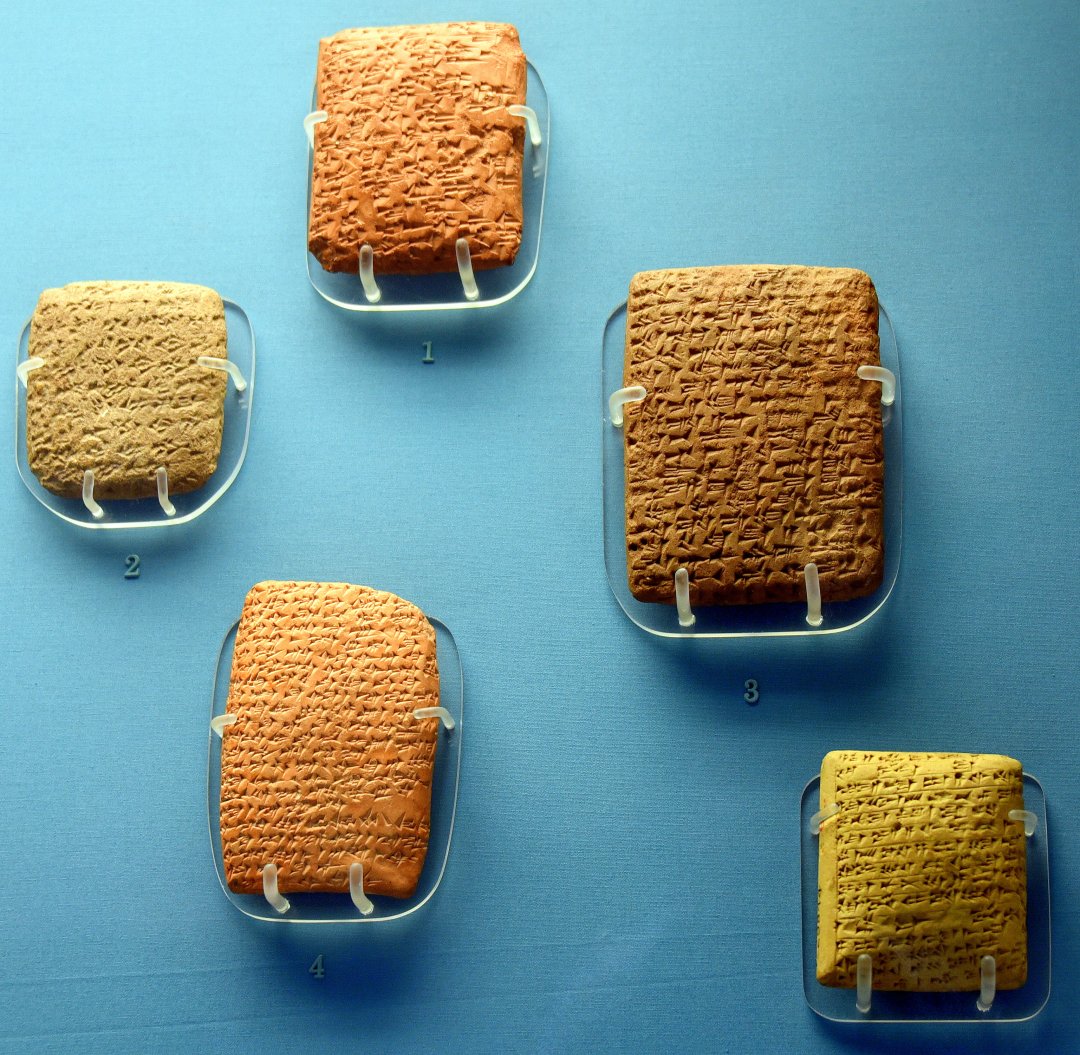
Fig. 1. Five Amarna Letters in the British Museum. Photograph courtesy of Osama Shukir Muhammed Amin via Wikimedia Commons / Creative Commons Attribution-Share Alike 4.0 International license.
The peasant woman could never be located afterward, however. An alternate hypothesis favored by some scholars is that the tablets were actually uncovered by a notorious Egyptian antiquities dealer named Farag Ismain (also referred to as Farag Ismail) who would have been digging at the site, likely illicitly, perhaps as early as the spring of 1887. While it is certainly possible that Ismain began his excavations because of the initial discovery by the local woman, the thinking is that he concocted and then spread the false story to cover his own activities. Whatever the origin of their find, the first tablets were offered for sale to museums and collectors by September or October of that year at the latest (and possibly a few months earlier).
As it turned out, the hundreds of inscribed clay tablets unearthed at the site were part of a royal archive belonging to Akhenaten and his father Amenhotep III. They include approximately fifty letters exchanged with the other “Great Kings” (a literal translation from the Akkadian šarru rabû), ranging from the Hittites in ancient Anatolia to the Assyrians and Babylonians in Mesopotamia and others in Cyprus, Mittani, and elsewhere. There are also close to three hundred additional letters that were sent by both vassal and more autonomous rulers in Canaan—the region of what is now modern Syria, Lebanon, Israel, Jordan, and the Palestinian Territories, over whom Egypt ruled during the fourteenth century BCE.
The letters cover a brief period of time, just under three decades long at most (ca. 1360–1334 BCE), from about the thirtieth regnal year of Amenhotep III through the third regnal year of Tutankhamun. The vast majority were apparently found in a single building at Amarna, known today as Building 19 but originally called something like “The House of the Letters of the Pharaoh—Life, Prosperity, Health” (Fig. 2). The building served as both a records office, which explains the presence of this royal archive, and perhaps also as a scriptorium, or scribal school, for there were also school texts found here.

Fig. 2. Tell el-Amarna in Egypt. Redrawn by Glynnis Fawkes.
*****
The digging at Amarna in 1887 was unintentionally observed at the time by an Oxford professor named Archibald Henry (A.H.) Sayce. At the time, he did not realize the significance of what he was witnessing. Eventually, however, the significance became so clear that he later wrote, “Next to the historical books of the Old Testament the Tel el-Amarna tablets have proved to be the most valuable record which the ancient civilised world of the East has bequeathed to us” (Sayce 1923, 251–52; also previously Sayce 1917, 89–90).

Fig. 3. Archibald Henry (A.H.) Sayce. Illustration by Glynnis Fawkes.
Sayce was late to the race to acquire and translate the Amarna tablets because of the death of his mother, or so he said. He and a friend had traveled from England to Greece and then to Cyprus “towards the end of November” in 1887, after his mother’s funeral. They stayed in Cyprus for two months, after which they headed to Jaffa and Jerusalem, and only then went on to Egypt. He thus missed all the initial “Amarna tablets excitement,” as he put it, in Cairo, Luxor, and elsewhere. Concerning that fateful period, he later wrote in his autobiography,
I have always regarded it as a proof that I was born under an unlucky star that the only winter which I did not spend on the Nile was the one when the famous cuneiform tablets were found by the fellahin at Tel el-Amarna. I had always stopped at Tel el-Amarna, generally both when ascending and when descending the river; I was well known to the fellahin and antika-hunters—two synonymous terms there—and what they had discovered in the mounds during the previous year was always brought to me for sale. The whole collection of tablets would have passed into my possession intact (Sayce 1923, 251).
At the time, Sayce was a well-respected Assyriologist, perhaps best known for his correct declaration a decade earlier that the Hittite civilization was located in Anatolia rather than down in Canaan as per the Hebrew Bible. He was of Welsh descent, with an aptitude for languages. He had begun reading Homer and Vergil by the age of ten and was reportedly conversant with ancient Egyptian hieroglyphics, Hebrew, and Sanskrit by the time he entered Oxford at the age of eighteen. Upon his graduation in 1869, he was asked to stay on as a fellow and tutor. By this point, he was forty-eight years old and had already been teaching at Oxford for more than twenty years; four years later, in 1891, he was appointed to a position as the first professor of Assyriology at the university and held that post until his retirement in 1915. He was also active in several professional societies, including the Royal Asiatic Society and the Egypt Exploration Fund, and was a founding member of both the Society for the Promotion of Hellenic Studies and the Society of Biblical Archaeology, serving as President of the latter for many years.
Sayce was soon able to get access to some of the tablets, which were now in the hands of Monsieur Urbain Bouriant, the director of the French School of Archaeology in Cairo. Sayce went to work translating these tablets and in late March and early April 1888, he published his preliminary identifications in two long articles, both of which appeared in The Academy, a periodical where he had frequently published previously, including an initial “Letter from Egypt” back in February, when he had first arrived in the country. The March article was also entitled “Letter from Egypt,” while the latter contained a bolder identification, with the title “Babylonian Tablets from Upper Egypt.”
In the March 1888 “Letter from Egypt,” Sayce concerned himself with a single tablet, noting that “M. Bouriant has been kind enough to let me copy one of the cuneiform tablets from Tel el-Amarna, which is in his possession.” Then he got straight to the heart of the matter: “The tablet is written in a neo-Babylonian form of cuneiform script, though some of the characters are peculiar; and it belongs to the period extending from the age of Assur-bani-pal to that of Darius” (Sayce 1888b, 211).
Since Sayce’s initial attempt to date this tablet covers a timespan of several centuries—the seventh to fifth centuries BCE—he subsequently tried to narrow down the date. In his April 1888 publication, after having seen a few more of the tablets in Bouriant’s possession, he said more specifically that the tablets were from the time of the Neo-Babylonian king Nebuchadnezzar in the late seventh century or early sixth century BCE. He stated his reasoning in no uncertain terms:
Most of the tablets contain copies of despatches sent to the Babylonian king by his officers in Upper Egypt; and as one of them speaks of “the conquest of Amasis,” whilst another seems to mention the name of Apries, the king in question must have been Nebuchadnezzar. The conquest of Egypt by Nebuchadnezzar, so long doubted, is now therefore become a fact of history. One of the tablets is addressed to “the king of Egypt,” the name of Egypt being written Mitsri, as in the annals of Nebuchadnezzar, and not Mutsri, as in the inscriptions of Assyria. In others the Babylonian monarch is called “the Sun-god,” like the native Pharaohs of Egypt (Sayce 1888c, 246–47).
To Sayce’s credit, some of these tablets, when they were eventually properly translated, did turn out to be letters from (or to) Babylonian kings. However, the kings in question ruled during the Middle Babylonian period, in the fourteenth century BCE, rather than during the Neo-Babylonian period, which began seven hundred years later.
We should perhaps not be too surprised by these misidentifications, given the haste with which Sayce translated and published these texts. Furthermore, making such initial errors was also apparently not out of the ordinary for Sayce, but he was not at all deterred nor did they appear to overly bother him, especially given the difficulties involved in identifying and interpreting the signs on these broken tablets. In fact, Sayce “was quite accustomed to making mistakes,” as the Egyptologist Frances Llewllyn Griffith later pointed out, for he felt that “progress in new fields is only possible by the process of trial and error” (Griffith 1933b, 65–66).
*****
Just a few weeks after Sayce’s initial offerings, a seven-page article about the Amarna tablets appeared in a German scholarly periodical, Sitzungsberichte der Königlich Preussischen Akademie der Wissenschaften zu Berlin. It was written by Adolf Erman, a thirty-four-year-old associate professor of Egyptology at the University of Berlin and Director of the Egyptian Department at the Royal Museum in the same city, in collaboration with a well-known senior Assyriologist, Eberhard Schrader (Erman and Schrader 1888).
Their work was based on 160 Amarna tablets that had been acquired by the Austrian antiquities dealer Theodor Graf, most likely from the antiquities dealer Ali Abd el-Hajj in Giza. Graf had promptly offered the tablets to the authorities in Berlin, with the cost of the purchase covered by James Simon, a textile magnate and friend of the Kaiser. These formed the nucleus of the current collection in the Vorderasiatisches Museum, where they were eventually supplemented by others.

Fig. 4. Adolf Erman, Carl Friedrich Lehmann, and Hugo Winckler. Illustration by Glynnis Fawkes.
In their article, Erman and Schrader disagreed with Sayce about the date of the tablets, stating in no uncertain terms that the tablets were from the Eighteenth Dynasty and specifically the Amarna Period, during the reigns of Amenhotep III and Akhenaten, which they dated to the fifteenth century BCE. They did not venture to suggest any actual translations but, among other things, stated that the material included letters exchanged between those two pharaohs and Burna-Buriash II, the king of Babylonia who was known from other published documents and could now be conclusively seen as a contemporary. There were also letters exchanged between Amenhotep III and Tushratta, the king of Mittani, a kingdom located in what is now northwestern Syria and northern Iraq and that also dated to the time of the Eighteenth Dynasty, not the Neo-Babylonian period. To put it bluntly, Erman and Schrader’s redating of the tablets hit the scholarly world like a bombshell.
In the interim, Sayce clearly realized that he had made a mistake, for he published another note on 9 June, admitting his errors in assigning a date and identifications to the tablets. However, he does not credit Erman and Schrader, or mention their article, which he may not have yet seen, but rather notes the efforts of two other young German scholars who had also been working on the tablets. One was Carl Friedrich Lehmann, a twenty-seven-year-old former lawyer who had just received his PhD from the University of Berlin and was now serving as Erman’s assistant; the other was Hugo Winckler, a twenty-five-year-old archaeologist and specialist in ancient Near Eastern languages who had also just received his PhD from the University of Berlin in 1886, where he had studied with Schrader. Winckler is now more frequently cited by archaeologists and historians for his excavations at Hattusa, the capital city of the Hittites in ancient Anatolia, and for his discovery of the Hittite archives at that site, but those would not be found for another two decades. His early work on the Amarna tablets, though often overlooked by nonspecialists, is just as important as his later work on the Hittites and includes important milestones en route to the final publications of the tablets.
In his new note, Sayce wrote:
The cuneiform tablets discovered last winter at Tel el-Amarna in Upper Egypt turn out to be even more interesting and important than I supposed. About 160 of them have been procured for the museum at Vienna [sic] and have been examined there by Drs. Winckler and Lehmann. The result of their examination shows that the Amasis, whose name is found on one of M. Bouriant’s tablets, does not belong to the XXVlth Dynasty, as I had imagined, but to the XVIIlth, and that the tablets themselves formed part of the archives of Amenophis III and IV. They consist, for the most part, of letters and despatches sent to these monarchs by the kings and governors of Palestine, Syria, Mesopotamia, and Babylonia; and, as some of them were written by Burna-buryas, King of Babylon, their age is about 1430 B.C. (Sayce 1888d, 397).
In his note, Sayce went on to discuss his belief that one of the tablets contained a reference to the sun god Masu, which he believed was “letter for letter” the same as the Hebrew word for Moses. He suggested, therefore, that this was “a name already known in Egypt a hundred years before the date assigned by Egyptologists to the Exodus” (Sayce 1888d, 397). He persisted in this line of reasoning for some time, though he was later taken to task by other scholars for its incorrectness.
Sayce was eventually gracious enough to admit his error about the dating of the tablets and to explain in his autobiography how it came to be. According to him, he initially “was unable to assign a date to the tablets, as those which I had copied contained no indications of their age, and the form of the script was new and so could not be compared with anything previously known; in a letter to the Academy, however, I ventured to suggest the age of Nebuchadrezzar, which soon turned out to be some eight hundred years too late” (Sayce 1923, 258–59).
*****
That same month, in June 1888, Sayce officially published his preliminary translations of the thirteen tablets which he had been shown by Bouriant. His article appeared in the prestigious Proceedings of the Society of Biblical Archaeology (Sayce 1888e). These new translations were very different from his earlier versions sent to The Academy (which Sayce strategically does not mention in this new article) but were still riddled with problems. Some of these mistakes were his fault entirely, caused in part by his eagerness to find mentions of biblical people and places in the tablets, but others came from the general status of the field at the time.
I will highlight here only a few of the problems in Sayce’s publication of these thirteen tablets in order to demonstrate the problems involved in being one of the first to attempt a translation of these letters. For instance, Sayce thought that one of the tablets (EA 290) was a letter sent to the pharaoh from someone named “Arudi,” who was concerned with someone else named “Melech the son of Marratim” and cities called Gaturri, Gimti, Kilti, and “Sadu-rurusi.” This turned out to be very far afield, for we now know that it is actually a letter sent to the Egyptian pharaoh by Abdi-Heba, who was the ruler of Jerusalem and who was concerned at that moment with a military action by Milkilu of Gezer (not Melech the son of Marratim), who had used his own troops as well as those of Gath and Qilti to attack Jerusalem (Sayce 1888e, 494–96; see also Sayce 1889c, 9 for a slightly different, yet still erroneous translation). By 1890, Sayce and other translators belatedly realized that it was, in fact, Jerusalem that was being named (rather than “Sadu-rurusi”), but it took even longer than that for the other people and places named on the tablet to be correctly identified.
Other misidentifications involved a tablet (EA 146) which Sayce thought mentioned Pharaoh Necho of Egypt (who lived seven hundred years later). It was actually a letter sent by Abi-Milku, the ruler of Tyre, who—as it turned out—had sent a number of additional letters also found in the archive. Another tablet (EA 157), which Sayce thought also mentioned Pharaoh Necho or rather “of the country of Necho,” does not do that either. Instead, it is a letter sent by Aziru, the ruler of Amurru, a Canaanite kingdom in northern Syria located to the south of the city of Ugarit; it is one of many letters either sent by Aziru or that mention him. Rather than discussing Necho or his country (which would have been Egypt), Aziru was actually discussing the Hittites in Anatolia, whom Aziru worried would declare war against him.
Sayce also elaborated on the tablet (EA 211) that he had included in his 9 June Academy note and that he thought mentioned Moses fully “a century before the date of the Exodus.” Unfortunately, this identification too was erroneous. It is simply a letter sent by someone named Zitriyara, the ruler of an unnamed city, who also sent three other letters to the Egyptian pharaoh.
Sayce did a better job on his translation and interpretation of the eighth tablet (EA 33). He correctly identified the sender as the king of Alashiya, which is now generally accepted as the Bronze Age name for all or part of ancient Cyprus, and the recipient as an unnamed pharaoh of Egypt. He was also almost correct in thinking that there were “200 pieces of bronze” mentioned, although scholars now more usually think that copper is meant, rather than bronze (and, in fact, the word after the number two hundred is missing, so modern renditions usually supply “talents” for the ancient measurement rather than simply “pieces”).
However, he was wrong in asserting that there was a mention in this letter of “the black stone of Solomon” at one point (line 14). As emeritus professor Amanda Podany has pointed out, the mistake is understandable, for the cuneiform signs preserved in that line reads “[ … ]-te-mè šu-ul-ma-na.” One can see how the word šu-ul-ma-na (which we now know means “well-being”) could easily be mistaken for the name “Solomon” by someone like Sayce who was keen to find Biblical allusions, especially given how broken the text is at this point.
Sayce also continued to claim that the sixth-century BCE Egyptian pharaoh Amasis was mentioned in line 9 of the ninth tablet (EA 107), as he had previously declared in several of the earlier “Letters from Egypt.” Instead, that line has nothing to do with Amasis but is part of a declaration by Rib-Hadda, the ruler of Byblos, swearing that he is a loyal servant of the pharaoh and always speaks the truth.
Rib-Hadda also sent the tenth and eleventh tablets, though Sayce managed to read the tenth tablet (EA 122) backward, so that what he thought was the front side is actually the back side, and vice versa. His translation, therefore, has the opening lines of the greeting from Rib-Hadda to the unnamed king of Egypt in the middle of the letter, rather than at the beginning as it should have been. Sayce repeated this same mistake with the eleventh tablet (EA 103); both errors were eventually corrected by other scholars.
Finally, Sayce mangled in grand style the thirteenth and final tablet (EA 14), which actually consisted of two large fragments. As he phrased it, “the nature of the tablet to which these fragments belonged is very evident. It was an inventory of certain property belonging to the Egyptian king, and stored by him in his new capital of Khu-Aten, ‘the glory of the solar disk.’” However, we now know that the two fragments come from a letter containing a very long list of goods that were being sent as a gift from Akhenaten to Burna-Buriash II, the king of Babylonia, and not the other way around, upon the occasion of Akhenaten’s marriage to the latter’s daughter, either as a bride-price or simply as a gift. The opening of the letter is now seen as reading, “[These items Naphuru]re’a, great king, [king of Egypt, s]ent [to his brother, Burna]burariash [Great King, king of Karaduniash] [when he (Burnaburiash) gave his daughter to] him.” In Sayce’s defense in this case, the tablet is not in good shape and many of the signs have had to be restored, including part of the verb “sent.”
Overall, the extent of these errors by Sayce may, on the surface, seem surprising, especially given his status as a highly respected philologist and Orientalist. However, as British Egyptologist Griffith said in his obituary for Sayce, his “vivid imagination and insight framed pictures of events and of interpretation in which he too often mistook the sharp lines of the picture for fact” (Griffith 1933b, 65–66). His ability to admit his errors and change his mind as necessary was therefore crucial, given this style.
*****
Just as that year came to a close, Sayce published another “Letter from Egypt,” in the 29 December issue of The Academy. In it, among other items, he discussed a letter (now identified as Amarna Letter EA 158) which he thought had been sent by Aziru of Amurru to his father Dûdu, concerning a garden that Aziru had been laying out. Indulging himself in one of his biblical flights of fancy, Sayce linked the name Dûdu to the name David in the Hebrew Bible, which had never been found outside the Bible at that time, and noted that “it is interesting to find it [the name] borne by a high official at the court of the Pharaoh in the century before the Exodus” (Sayce 1888f, 424–25). As will be no surprise by now, Sayce was wrong once again, as he eventually learned when it was republished more accurately by other scholars.
However, in the interim, Sayce included this tablet, and his erroneous interpretation of it, in a long article which he published in the PSBA six months later, in June 1889. The article was concerned with thirty-three tablets that were in the Cairo Museum (known at the time as the Bulaq Museum). Sayce was now of the opinion that Dûdu was a high official at the court of the pharaoh and was even possibly stationed in Phoenicia (i.e., Canaan). He was still particularly excited by Dûdu’s name, seeing it as “the Biblical Dodo, Dod or David, [which] has hitherto never been found outside the Old Testament,” and by the fact that the father of a Canaanite minor ruler could have held such a high position at the Egyptian court (Sayce 1889b, 344–45, no. IX; see also discussion in Sayce 1889c, 20–21).
We now know that Dûdu was indeed a very high Egyptian official, for he was a royal vizier whose name we now usually read instead as Tutu and who has nothing to do with David, Dod, or Dodo. He was also not Aziru’s actual father, for in the Amarna Letters this was simply a term of respect used for a political superior and had nothing to do with actual kinship. Aziru’s real father was named Abdi-Ashirta.

Fig. 5. Joseph Halévy. Illustration by Glynnis Fawkes.
Other scholars began taking Sayce to task for such mistaken identifications. For instance, Joseph Halévy, who was an Orientalist and biblical scholar originally born in Turkey but now based in Paris, castigated Sayce for announcing that he had identified Moses in the Amarna Letters. He began by saying that “to be truly useful to the progress of history and exegesis, it is necessary to begin by barring the way to any hasty or exaggerated hypothesis, to any conclusion which is not based on an exact interpretation of the texts.” Without explicitly mentioning Sayce by name, he added that nothing had been more prejudicial to the study of these new texts than the haste by which “the discovery of the names of Moses and of the Hebrews in the tablets preserved at Boulak” had been announced. “Usually such claims,” he said, “have their source in the misinterpretation of a word, sometimes even of a single letter. We regret to say that the starting point of the astonishing pre-Hebraic discovery which I have just mentioned is no more solid” (Halévy 1890a: 199–200; translations from the original French by E. H. Cline). Similarly, David Gordon Lyon, the Hancock Professor of Hebrew and Other Oriental Languages at Harvard University, said just a few years later, on the occasion of the laying of the cornerstone at the Haskell Oriental Museum of the University of Chicago in 1896, “I bring gladly this just tribute to the work of Professor Sayce, although I have had, along with other Assyrian and biblical scholars, repeated occasion to regret the haste of many of his recent utterances” (Lyon 1896, 131). One can hear the exasperation in his voice even now, more than 125 years later.
*****
However, Sayce was not always wrong. In the 19 April 1890 issue of The Academy, in his by now familiar “Letter from Egypt” column, he casually mentioned in the very last paragraph that he had identified Jerusalem in a single Amarna tablet, EA 290 (which we have mentioned above). “I have examined afresh one of the letters from Southern Palestine contained in the Tel el-Amarna collection,” he said, “in which mention is made of the cities of Keilah, Kirjath, and what I read doubtfully as Ururusi. … My copy, however, subsequently made me think that it really was … the name reading Uruśalim, or Jerusalem. Another inspection of the tablet has shown me that my conjecture was right, and that the city of Jerusalem already existed under its familiar name in the fifteenth century B.C. It was at that time a garrison of the Egyptian king” (Sayce 1890a, 273). As an aside, we should note that less than six months earlier, during a lecture in Manchester in early November 1889, Sayce had not yet realized that “Ururusi” was in fact Jerusalem: “We seek in vain in later history for the name of Ururusi, which appears as a city of equal importance with Gath and Gaza,” he said at the time (Sayce 1889c, 11).
Sayce was absolutely correct that Ururusi was actually Jerusalem, but one has to ask why he had decided to examine “afresh” this one tablet. A compelling reason is readily found, courtesy of an anonymous note which appeared six months later in The Academy. This note stated that there were now five Amarna tablets in Berlin that had been identified as mentioning Jerusalem: “Among the tablets from Tel el-Amarna, now in the museum at Berlin, five have lately been found which were sent from Urusalim or Jerusalem to the Egyptian kings. Their writer was a certain Additaba or Hadad-tob [now identified as Abdi-Heba], who claims to have been a tributary and protected prince, and not merely an Egyptian governor” (Anonymous 1890, 340). The anonymous writer went on to acknowledge that Sayce had also discovered the name of Jerusalem in one of the tablets that was now in the Cairo Museum, citing Sayce’s note from April.
We do not know the author of this note, but it is clear what had happened. All of the tablets in Berlin had been published in a two-volume set, in 1889 and early 1890, by Hugo Winckler and Ludwig Abel. In the second volume, the name Jerusalem appeared on six Berlin tablets (rather than five), which Winckler and Abel published as numbers 102–6 and 174. Rumors must have been flying both before and after publication, probably compelling Sayce to hastily reexamine his own tablets and publish his note in April 1890.

Fig. 6. Heinrich Zimmern. Illustration by Glynnis Fawkes.
These specific tablets were also mentioned by Heinrich Zimmern, a twenty-eight-year-old Assyriologist who had studied at Berlin with Schrader, in a brief article that he published in the Kölnische Zeitung on 1 October 1890 (Zimmern 1890b), just three weeks before the anonymous notice appeared in The Academy. It seems extremely likely that Zimmern was in fact the author of the note in The Academy, for he discussed the tablets twice more in 1891 (Zimmern 1891b; 1891c, 137–40).
The anonymous note in the 18 October 1890 issue of The Academy was followed by a fuller, and more specific, discussion by Sayce, as a response published in the 25 October issue. Here he expanded on his notice from the previous April, though curiously he does not mention that earlier note in this longer response.
The discovery of despatches from Jerusalem to the kings of Egypt in the fifteenth century B.C., announced in the Academy of last week, throws light on one of the tablets from Tel el-Amarna, belonging to M. Bouriant, which I copied three years ago. The imperfect condition of the tablet prevented me at the time from realizing its importance, though I was able to identify in it the names of the cities of Gedor, Gath, Keilah, and Rabbah. But I see now that it also contains a reference to Jerusalem, which is of considerable interest. The passage is as follows … (Sayce 1890b, 366).
Sayce then took the opportunity to provide a suggested transliteration and translation, which he rendered as “the city of the mountain of Jerusalem, the city of the temple of the god Uras: (his) name (there is) Marruv; the city of the king, adjoining (?) the locality of the men of the city of Keilah.” He then continued: “Here Jerusalem is distinctly marked out as situated on a mountain, and as being the seat of a famous temple. … At all events, we must see in the deity whose temple stood on ‘the mountain of Jerusalem,’ the êl elyôn, ‘the most high God,’ of Gen. xiv.18” (Sayce 1890b, 366).
Sayce’s misinterpretation regarding a deity named Uras was based on an erroneous translation of some of the words in this passage, as Zimmern subsequently pointed out in his longer 1891 article in Zeitschrift des Deutschen Paläistina-Vereins. Instead, these lines simply say: “ … a town belonging to Jerusalem, Bit-dNIN.IB by name, a city of the king, has gone over to the side of the men of Qilti (Keilah)” (Zimmern 1890c, 142n4; translation following Moran 1992, 334). In short, the letter is concerned with political and military matters, not religious. It is yet another cautionary tale about Sayce’s translations and his desire to connect the material in the Amarna archive to the Hebrew Bible whenever and wherever he could.
Near Eastern scholars looking for biblical connections at this time was not unusual, particularly since many of them were also practicing ministers with degrees in theology. As we have seen, Sayce, who was an ordained minister, was similarly intent on linking these texts to the biblical accounts. He had begun his 1889 Manchester lecture by saying:
A marvelous discovery has recently been made in Egypt, so marvelous, indeed, that had a prophet arisen to predict it to our fathers or our grandfathers they would have listened to him with scornful incredulity. We have been suddenly brought face to face with the civilised world as it existed in the days when the Israelites were groaning under the burdens of their Egyptian taskmasters; we can handle the very letters that were written by the princes and governors of Canaan when as yet Joshua was unborn, and we can trace the course of events that led to the mission of Moses and the exodus of Israel out of Egypt (Sayce 1889c, 1).
He then continued:
Consider for one moment what an important bearing such a discovery must have upon the criticism of the Old Testament. We have hitherto taken it for granted that the world of Moses was narrow and circumscribed, that a knowledge of letters was confined to a few in the cultivated kingdoms of Egypt and Babylonia, and that the populations of Canaan were as illiterate as the populations of Europe in the Middle Ages. Suddenly the veil has been drawn aside which has for centuries hidden that ancient world from our eyes, and we find it a world much like our own, educated and literary, constantly informed of all that was passing in the countries around it, and enjoying an advantage which we no longer possess—that of a common medium of literary intercourse (Sayce 1889c, 7).
Sayce persisted in presenting the name of the ruler of Jerusalem as Ebed-tob instead of Abdi-Heba and continued to talk about Jerusalem as “the seat of the worship and oracle of the god ’Salim, whose temple stood on ‘the mountain’ of Moriah.” He explained this to his readers by stating that the word uru meant city, which it does, and that therefore Uru-’salim meant “the city of the god ’Salim” (Sayce 1891, 60–63). Though this is not out of the question, the meaning of the name has been much debated over the years, and this is by no means the only possible interpretation, though Sayce’s biblical focus kept him on this track.
In addition, Sayce claimed that the ruler of Jerusalem wrote to the pharaoh at one point (EA 288), saying that “The country of the king is being destroyed, all of it. Hostilities are carried on against me as far as the mountains of Seir, and the city of Gath-Karmel.” According to Sayce, the king continued, “(There is) peace to all the (other) governors, but war against myself is raised,” and then quoted an “oracle of the mighty king” saying, “While (there is) a ship in the midst of the sea … the conquests shall continue of the country of Nakhrima and the country of Babylonia. And now the fortresses of the king the Confederates are capturing. Not a single governor remains (among them) to the king my lord; all are destroyed” (Sayce 1891, 69; see also Zimmern 1891b, 259).
While the essential meaning of Sayce’s translation of this letter was correct, large parts of it were not, including the so-called oracle that Sayce quoted. These lines are now translated as: “The king should show concern for his land. The king’s land is out of (his) control. Its entirety has been seized from me. (There is) hostility towards me. From the mountains of Šeru to Gintu-Kirmil, (there is) peace for all of the city rulers, but (there is) hostility towards me!” The text then continues, “I am placed like a ship in the middle of the sea! The strong hand of the king captured the land of Mittani and the land of Cush, but now the ‘apiru are capturing the king’s cities. There is not a single city ruler belonging to the king, my lord. All are out of (his) control!” (Lauinger and Yoder 2025: 453–56).
Meanwhile, over in the United States, an American scholar finally ventured into the Amarna arena. Morris Jastrow Jr., an American Assyriologist who had studied with the renowned Assyriologist Friedrich Delitzsch in Leipzig, receiving his PhD in 1884, and who was now teaching at the University of Pennsylvania, published an article in the 1892 volume of the Journal of Biblical Literature. The article was derived from a paper that Jastrow had delivered at a meeting of the Society of Biblical Literature and Exegesis a few months earlier. It was meant to show “Old Testament students” the general importance of the Amarna tablets in understanding the relations between Egypt and Canaan ca. 1400 BCE.
Jastrow spent by far the greater part of his article commenting on the occurrence of Jerusalem in the tablets, giving credit to Sayce for having been the first to announce this. He also noted that the letters mentioning Jerusalem had recently been published by Winckler and Abel in their volumes and that both Zimmern and Halévy had weighed in already with their own transcriptions and translations. However, even in giving credit to Sayce for the initial identification, Jastrow pulled no punches, stating in a footnote: “Sayce in various articles … by falsely interpreting the ‘mighty King’ to refer to a deity, has drawn conclusions from these passages as to the religious ideas prevalent in Jerusalem at this period that are totally erroneous. The ‘mighty King’ can only refer to Amenophis IV. It is to be regretted that the distinguished English scholar should have been so hasty in spreading his conjectures through the medium of popular journals, thereby doing a mischief of incalculable extent” (Jastrow 1892, 106n25).
He also commented specifically on the lines in which Abdi-Heba described himself as a “ship in the midst of the sea,” stating that these had given everyone trouble, including Halévy and Zimmern, as well as Sayce. Jastrow’s attempt was no better, for he rendered it as “If any one were to see [my condition], he would see the tears of the King my lord at the hostility that is being carried on against me, as when a ship is [cast about] in the midst of the sea” (Jastrow 1892, 114n37).
Jastrow also devoted a fair amount of his article to a topic which has been much discussed ever since. Throughout a number of the Amarna Letters, including from Abdi-Heba in Jerusalem, mention is made of a group of people collectively known to the writers as the ‘apiru or habiri. Sayce had been arguing for some time that the term should be translated as “confederates” or “allies” but others, including Zimmern, thought that this was none other than a reference to the “Hebrews” and that we should see here the first indication of the arrival of the Israelites in the land of Canaan.
Jastrow was of the belief that while the identification of the ‘apiru as the Hebrews was tempting, he also warned that “the proposed identification would have to be received with the greatest caution” (Jastrow 1892, 118, also 119–22). Indeed, while the association was deemed acceptable by a number of scholars right up until the 1970s, the majority no longer agree and instead now see the ‘apiru more along the lines of a social class rather than an ethnicity or specific nationality, and do not identify them with the Hebrews.
*****
In sum, it is not hard to see why Sayce said in his autobiography that “Next to the historical books of the Old Testament, the Tel el-Amarna tablets have proved to be the most valuable record which the ancient civilized world of the East has bequeathed to us” (Sayce 1923, 251–52). It is also not difficult to ascertain why Sayce was searching for connections to the Hebrew Bible, for it was at precisely this same time that Austen Henry Layard and others were finding and uncovering for the first time Neo-Assyrian and Neo-Babylonian cities in Mesopotamia. Those excavations began producing evidence which confirmed some of the biblical accounts, such as the Neo-Assyrian king Sennacherib attacking Lachish, the second-most powerful city in the kingdom of Judah at the time (701 BCE). Layard had published a revised edition of his best-selling book Nineveh and Babylon in 1882, just five years before the discovery of the Amarna Letters. There can be no doubt that Sayce was eagerly looking for similar evidence in those letters, which no doubt contributed to his initial erroneous date for the archive as well as to his unfortunate musings about Solomon, David, and Jerusalem.
References
Anonymous. 1890. “Notes and News.” The Academy Vol 38 no. 963 (Oct 18): 340.
Erman, A., and E. Schrader. 1888. “Der Thontafelfund von Tell-Amarna.” Sitzungsberichte der K. preussischen Academie der Wissenschaften zu Berlin Philologisch-historische Klasse 23: 583–89.
Griffith, F. Ll. 1933b. “Archibald Henry Sayce.” Journal of Egyptian Archaeology 19 (1/2): 65–66.
Halévy, J. 1890a. “La correspondance d'Amenophis IV et la Bible.” Revue des etudes juives XX/40: 199–219.
Lauinger, J., and T.R. Yoder. 2025. The Amarna Letters: The Syro-Levantine Correspondence. Columbus, GA: Lockwood Press.
Layard, A.H. 1882. Nineveh and Babylon: A Narrative of a Second Expedition to Assyria During the Years 1849, 1850, & 1851. Abridged. New Edition. London: John Murray.
Lyon, D.G. 1896. “A Half Century of Assyriology.” The Biblical World 8/2: 124–42.
Moran, W.L. 1992. The Amarna Letters. Baltimore: Johns Hopkins University.
Sayce, A.H. 1888b. “Letter from Egypt.” The Academy 33, No. 829 (March 24): 211.
Sayce, A.H. 1888c. “Babylonian Tablets from Upper Egypt.” The Academy 33, No. 831 (April 7): 246–47.
Sayce, A.H. 1888d. “The Name of Moses in the Cuneiform Tablets of Tel el-Amarna.” The Academy 33, No. 840 (June 9): 397.
Sayce, A.H. 1888e. “Babylonian Tablets from Tell el-Amarna, Upper Egypt.” Proceedings of the Society of Biblical Archaeology X: 488–527.
Sayce, A.H. 1888f. “Letter from Egypt.” The Academy 34, No. 869 (December 29): 424–25.
Sayce, A.H. 1889b. “The Cuneiform Tablets of Tel el-Amarna, now Preserved in the Boulaq Museum.” Proceedings of the Society of Biblical Archaeology XI (June 4): 326–413.
Sayce, A.H. 1889c. “Letters from Syria and Palestine before the Age of Moses.” Transactions of the Lancashire and Cheshire Antiquarian Society VII: 1–25.
Sayce, A.H. 1890a. “Letter from Egypt.” The Academy Vol. 37, No. 937 (April 19): 273.
Sayce, A.H. 1890b. “Jerusalem in the Tablets of Tel el-Amarna.” The Academy (Oct 25) Vol. 38, No. 964: 366.
Sayce, A.H. 1891. “Correspondence between Palestine and Egypt in the Fifteenth Century B.C.” Records of the Past, New Series, Vol. V: 54–101.
Sayce, A.H. 1917. “The Discovery of the Tel el-Amarna Tablets.” American Journal of Semitic Languages 33/2: 89–90.
Sayce, A.H. 1923. Reminiscences. London: Macmillan and Co.
Zimmern, H. 1890b. “Die ältesten Schriftstücke aus Jerusalem.” Kölnische Zeitung, Oct. 1st, 1890.
Zimmern, H. 1891b. “Die Keilschriftbriefe aus Jerusalem.” Zeitschrift für Assyriologie VI: 245–63.
Zimmern, H. 1891c. “Palästina um das Jahr 1400 v. Ch. nach neuen Quellen.” Zeitschrift des Deutschen Paläistina-Vereins XIII: 133–47.
[*] The following is excerpted from Love, War, and Diplomacy: The Discovery of the Amarna Letters and the Bronze Age World They Revealed © 2025 by Eric H. Cline. Reprinted by permission of Princeton University Press.
Article Comments
So are we to conclude from…
So are we to conclude from Abdi-Hepa’s remarks that something which amounts in our terms to class warfare was afoot in the Holy Land? I think I’ve heard of that idea before
Submitted by Mark Elliott In…
Submitted by Mark Elliott
In an added note to Clines’ excellent piece on Sayce and the Tel el-Amarna tablets, there is Sayce’s utilization of the tablets to attack Wellhausen and higher criticism of the Bible. At the end of the nineteenth and early twentieth centuries, Sayce was the most articulate opponent of higher criticism, and for more than 30 years, he vigorously objected to the negative assertions of higher critics. Sayce's writings and arguments in defending many aspects of the biblical record from its skeptics were incorporated into later works by serious scholars and confessional elements.
The discovery of the Tell el-Amarna letters “revolutionized” his perspective on higher criticism (Sayce 1923, 272-73). He recognized writing was widespread throughout the Near East and, more importantly, was ancient. For Sayce, the decipherment of the Tell el-Amarna tablets assuredly refuted the documentary hypothesis, which proclaimed that writing was unknown at the time of Moses. “It was henceforth plain that the assumption of the late date of the literary use of writing was false…. it was no longer possible, except for the ignorant to maintain that literary works that we find in the Old Testament, could not have existed in the Mosaic era” (ibid.). Higher critics were wrong to insist the Bible was written centuries after the events occurred. Sayce insisted archaeology had easily demonstrated faulty German critics could no longer argue that early Israel could neither read nor write until the Exile. These early Egyptian tablets convinced Sayce that "hence forward the character and credibility of a Hebrew document must be settled not by the assumptions, subjective fantasies or ignorance of the critic, but by archaeological research” (ibid.). According to Barbara Zink MacHaffie, by 1895 Sayce was writing that German criticism had no “legitimate role to Old Testament criticism” especially since the advent of “important and crushing replies” of archaeology. He also expressed concern that German critics failed “to recognize the doubts which their theories cast on the teaching authority and miracles of Jesus” (MacHaffie 326-27). Of course, this became a recurrent theme for conservatives. If higher criticism was widely endorsed, the consequences were indisputable: Jesus was not divine, and his teachings were false.
MacHaffie, B.Z. 1981. Monument Facts and Higher Critical Fancies: Archaeology and the Popularization of Old Testament Criticism in Nineteenth-Century Britain. Church History 50(3): 316–328.
Sayce, A.H. 1923. Reminiscences. London: Macmillan and Co.
On the Sayce-Drive debate see, Biblical Archaeology and Its Interpretation: The Sayce-Driver Controversy
On the Conservative attack on higher criticism see, Elliott, Mark. “Defending Scripture through Spiritual Archaeology.” In In Pursuit of Visibility: Essays in Archaeology, Ethnography, and Text in Honor of Beth Alpert Nakhai, edited by Jennie Ebeling and Laura Mazow. Archaeopress, 2022.
Well, such things happened whenever we had this kind of discoveries in the Middle East. Just think of Abraham mentioned in Ebla tablets. It says a lot about the motivation behind oriental studies, and about what ordinary people want to hear. As a matter of fact it says a lot about the Hollywood perspective of most modern people.
From someone who simply loves these letters.